
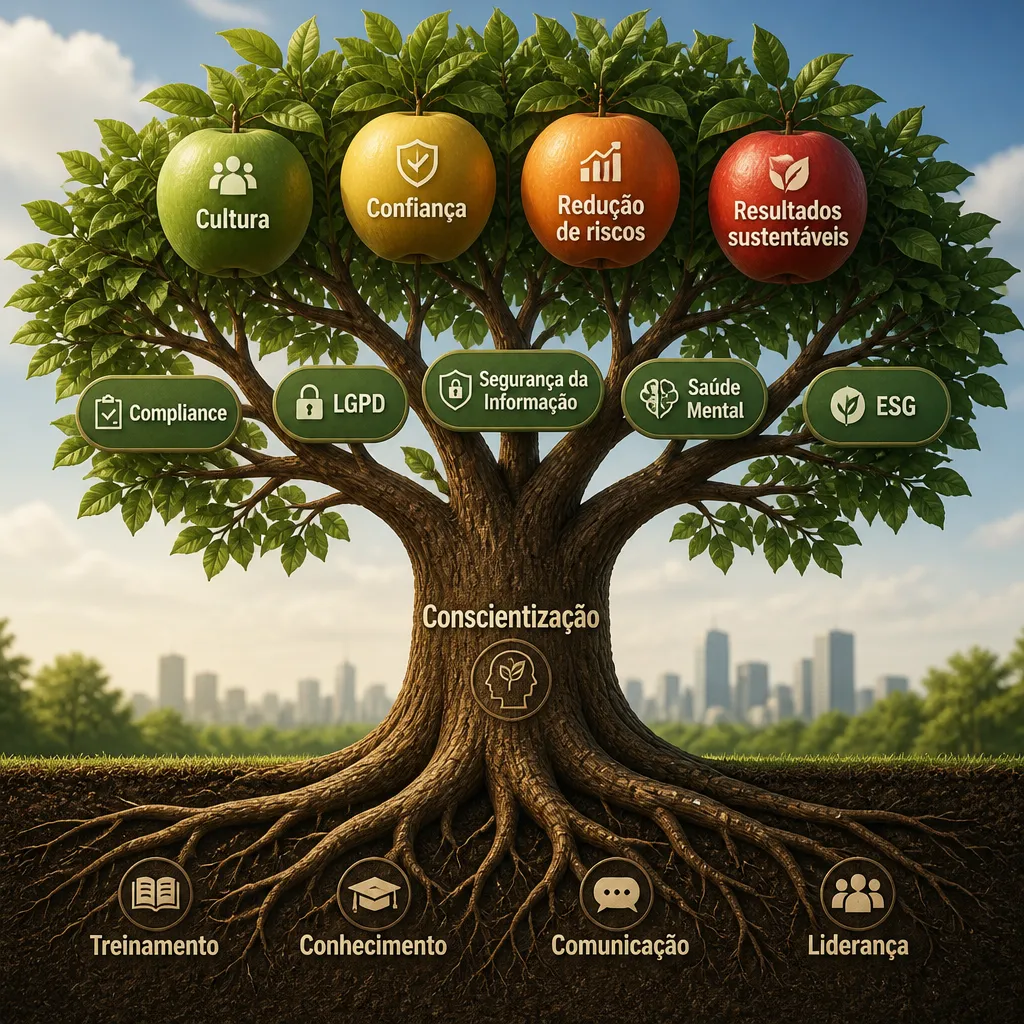
Your company trained its employees. But did behavior actually change?
Many organizations invest in training believing that education, on its own, is enough to mitigate risks. However, there is a major difference between training people and building a culture.
True organizational culture shows up in the decisions employees make when no one is watching. It manifests in how they handle personal data, respect colleagues, identify risks, or report inappropriate behavior.
That is why one question has been gaining traction among managers, auditors, and experts: How do you know if training has actually triggered a behavior change?
In this article, we present the top five signs that your training might not be delivering the expected results.
What does it mean to build a Compliance culture?
A compliance culture doesn’t just happen when everyone completes a training session. It happens when employees:
Know the rules;
Understand the risks;
Make decisions aligned with the organization’s values;
Apply the acquired knowledge in their daily routines;
Positively influence the behavior of others.
1. The same mistakes keep happening
This is the first sign that the training may not have been effective. If, after a training session, situations like these continue to occur:
Improper sharing of personal data;
Information security failures;
Cases of harassment or misconduct;
Non-compliance with internal policies;
Recurring compliance incidents; It is crucial to evaluate whether the knowledge was truly absorbed. When behavior doesn’t change, training risks becoming just a box-checking exercise.
Question for reflection: If an audit were conducted today, would your company be able to demonstrate a reduction in risks following the training sessions?
2. Employees quickly forget the content
You have probably experienced this: Someone completes a training session with an excellent score and, a few weeks later, cannot explain basic concepts. This happens because the human brain wasn’t designed to store information that isn’t used regularly. Knowledge retention drops significantly without periodic reinforcement.
That is why more mature companies invest in:
Continuous learning tracks;
Awareness campaigns;
Microlearning;
Quizzes;
Recurring communications.
3. Leadership does not reinforce the expected behaviors
No awareness initiative survives without leadership support. When managers ignore topics related to ethics, privacy, security, or workplace respect, employees receive an implicit message: “This is not a priority.” Conversely, when leaders demonstrate commitment to the cause, participate in training, and reinforce expected behaviors, the culture grows stronger.
4. The company measures participation, not learning
Many organizations track metrics such as:
Number of trained employees;
Completion rates;
Issued certificates.
While this data is important, it doesn’t reveal whether the knowledge was actually assimilated. The most relevant questions are:
Did the employee learn?
Did behavior change?
Did risks decrease?
Did the maturity level evolve?
What gets measured gets managed—and what isn’t measured can hardly be improved.
5. Training only happens when there is an obligation
Does your company only conduct training when:
An audit is approaching?
A regulatory requirement arises?
A client requests evidence?
An incident occurs?
If the answer is yes, it’s a strong indicator that awareness is being treated as a one-off task. Culture, however, doesn’t work that way.
What does science say about knowledge retention?
Psychologist Hermann Ebbinghaus demonstrated a phenomenon known as the “Forgetting Curve.” According to his studies, without reinforcement or practical application, a large portion of acquired knowledge tends to be forgotten over time. This explains why isolated training sessions rarely manage to transform organizational cultures.
Change happens when learning is continuously reinforced. In other words: People don’t learn just because they attended a training session. They learn because they keep practicing what they learned.
The goal is not just to transmit information; it is to develop behaviors that reduce risks and strengthen corporate governance.
Why training your employees matters
Training employees is one of the most effective ways to strengthen organizational culture and prevent risks. Knowledge helps people recognize hazardous situations and make safer decisions. However, to generate lasting results, training must be seen as the beginning of an awareness journey, not an isolated event.
Can your company prove that its training sessions are driving real behavior changes? Companies that can answer this question with concrete evidence are better prepared to mitigate risks, meet regulatory requirements, and build a solid, sustainable organizational culture.
How TothBe can help
TothBe transforms corporate training into unforgettable experiences—delivering results that companies can actually measure. Using active methodologies, gamification, storytelling, and high-quality content, each solution is designed to engage all hierarchical levels. After the training, the journey continues: practical, creative reinforcement materials and application resources lock in learning in day-to-day routines. To ensure real governance, TothBe provides comprehensive tracking reports and AI-generated executive summaries—fully validated by TothBe—based on the generated data, revealing the evolution of the learning program and supporting strategic decision-making.
The result? A culture that doesn’t rely on the memory of a single training event—but one that sustains, proves, and strengthens itself over time.
Come with TothBe!


